
SUSTAINABLE Disaster recovery
Through the involvement of the a broad community stakeholders, and integrating the social, economic, and environmental vulnerability indicators into the redevelopment decision making processes, this research aims to increase the individual utility of the participating entities while reducing the overall vulnerability of the built environment.
Such approach meets the recommendations of the US National Disaster Recovery Framework, and the UN International Strategy for Disaster Reduction.
To this date, this research resulted in five peer-reviewed journal papers, multiple other conference papers and an ASCE award.
STABLE DISASTER INSURANCE PROFILE - EVOLUTIONARY GAME
Utilizing evolutionary game theory, this project aims to find the optimal and stable disaster insurance profile. This is carried out through defining the Evolutionary Stable Strategy (ESS) between the residential sector and the insurance companies.
The developed evolutionary game depicts the heterogeneity among the residents as well as the different insurance plans offered by different insurers. Through social learning, resembling the replicator dynamics, the developed model can find the ESS of the developed game.

Scheduling Repetitive Activities Projects
Pipelines, railways, highways, apartment complexes, and high-rise buildings projects are all characterized by the repetition of a number of similar activities throughout the project. Such projects require the optimal utilization of resources to meet the project deadline, stay within budget, and increase the continuity of work (i.e., decrease the idle time of resources). In addition, project managers need to identify the optimal schedule that would meet the delivery dates of the different units, and account for the transportation of construction crews from one unit to the other.
This research focuses on the development of optimal schedules through evolutionary algorithms, dynamic programming, and construction site simulations. The ultimate goal is to develop practical and effective scheduling tools for practitioners that identify the optimal set of schedules to be utilized throughout the project life cycle.
Construction Joint Ventures - Marginal Contribution Agreements
Construction Joint Ventures (CJV) provide participants with cost-saving, resource pooling and market penetration benefits that cannot be acquired solely by each entity. Nevertheless, sharing the benefits of such collation should not be based on investment cost, but on marginal contribution. Through this research, the research team is trying to define the fair share of each collaborating party and provide a more stable agreement via cooperative game theory.


Cooperative Game theory for Integrated Project Delivery Systems for emerging markets
Integrated Project Delivery (IPD) systems has adoption has been on the rise. However, emerging markets that do not have IPD experience might require a transitional phase to bridge between the established traditional delivery systems and IPD. This research aims to bridge such gap through cooperative game theory.
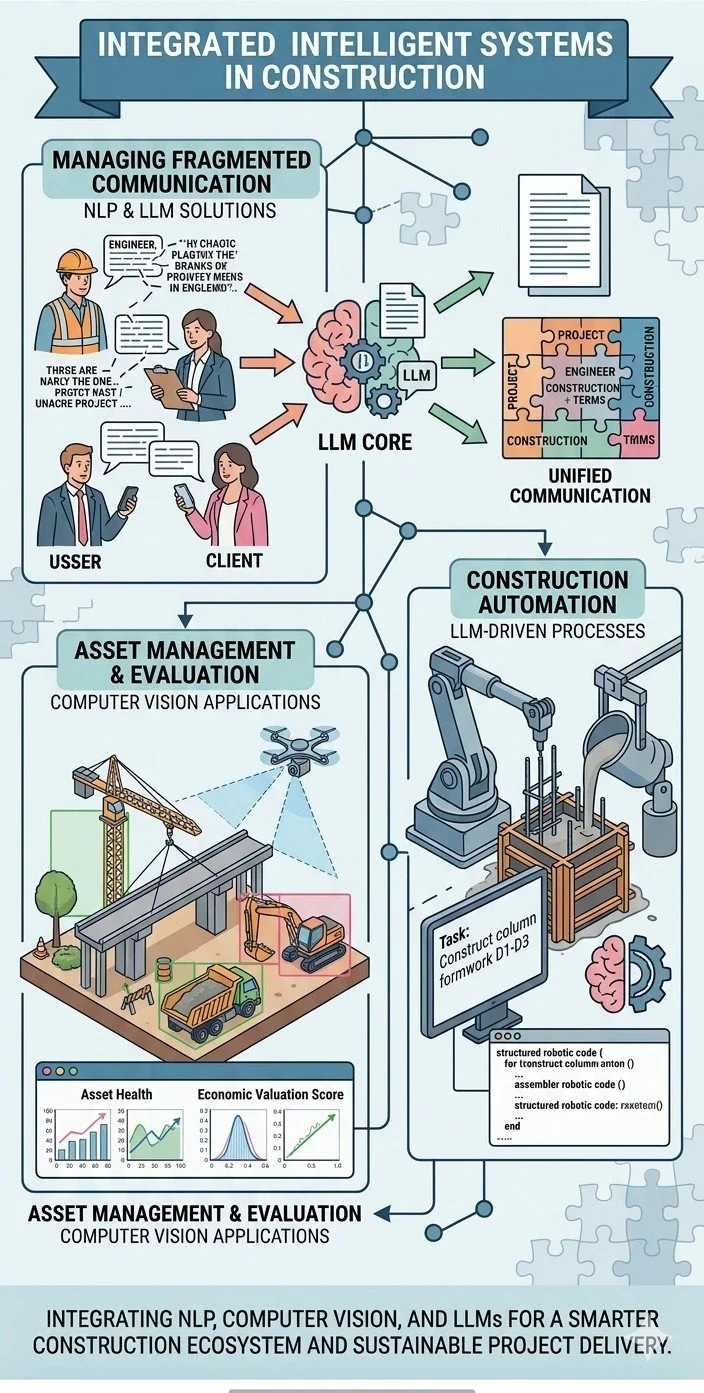
AI applications in Construction Engineering and Management
Construction project efficiency is significantly enhanced through a comprehensive suite of artificial intelligence tools. Fragmented communications are unified utilizing Natural Language Processing (NLP), Large Language Models (LLMs), and Machine Learning (ML). Through these tools, unstructured text is autonomously parsed, critical contract deadlines are extracted, and informal updates are translated into formal records. Simultaneously, physical site reality is evaluated by advanced computer vision pipelines. Visual data ingested from drones and site cameras is compared against Building Information Models (BIM) to automate progress tracking, monitor material stockpiles, and detect structural defects. Furthermore, technical office workflows are rigorously optimized via Agentic AI. Virtual agents are deployed to autonomously execute complex tasks, such as drafting procurement orders, running dynamic rescheduling simulations, and recalculating Bills of Quantities. By integrating these specific technological tools, operational bottlenecks are resolved, and accurate decision-making is seamlessly facilitated.